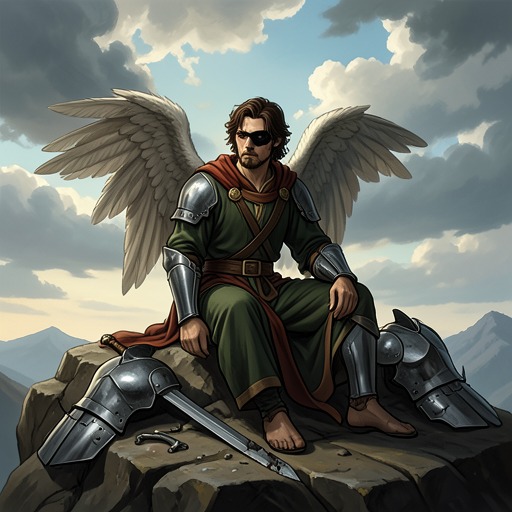
Heavenly War
Soul Guardian: A Hellishly Cozy FantasyThe Battle for Heaven is the ancient conflict that made the book’s supernatural order a history of divided loyalties rather than a simple struggle between virtue and wickedness. The war pitted Hell’s forces against Heaven, consumed armies on both sides, left Maharet Flameheart physically scarred, and continued to govern the choices of Bael-Sharoth, Zephyr, Ganon-Sharoth, and Gabriel long after the fighting ended.
Causes and Forces
The conflict grew out of Lucifer’s rebellion against Heaven. Bael-Sharoth served in the Infernal Infantry, while Maharet Flameheart belonged to Hell’s First Airborne, an elite formation composed of powerful demons sent deep behind enemy lines. Bael remembered his unit as nearly bringing down Heaven’s gates, whereas Maharet described the First Airborne’s more audacious operation: they teleported into Heaven and overwhelmed its defenses before Gabriel and Azrael entered the fighting. Their initial success made victory seem possible, but the arrival of those archangels turned the battle against them.
The war’s opposing armies were not presented as morally symmetrical in practice, even though both sides suffered and committed violence. Zephyr condemned Gabriel’s decision to send legions of angels to their deaths when God, being absolute and omnipotent, did not need defending. In Zephyr’s view, the battle continued because Gabriel’s ego demanded confrontation with the fallen. The war therefore appears not only as a cosmic rebellion but also as a political and military disaster intensified by commanders who treated sacrifice as proof of loyalty.
Course and Human Cost
Maharet’s account gives the war its most intimate physical mark. She was providing air support when a seraph came behind her and clipped her wings. The fall injured her so severely that she did not awaken until the war was nearly over. Her raised scars remain a bodily record of the conflict, and Bael-Sharoth responds to them with tenderness rather than the boastfulness that initially colors his own military memories.
Bael’s memories instead emphasize the comradeship that existed immediately before the assault. The last time he spent time with real friends was just before the charge on Heaven’s gates, when he and his companions shared stolen Elysian ale and boasted about being the first to cross the threshold. Those companions were a thousand of his brothers, identical beings formed from the same mold rather than born. Lucifer had taken a portion of her essence and given it to each of them, creating an army of shock troops intended to break through Heaven’s defenses for the rest of her forces. Their standardized origin makes the loss both military and personal: they were manufactured as weapons, yet Bael remembers them as friends.
The war ended in defeat for Hell’s forces. Bael described the Infernal Infantry with pride, but the surviving demons were left to carve out lives in Hell after the rebellion failed. Zephyr’s later definition of peace makes the cost explicit: peace is a future gift purchased by the blood and sacrifice of those who fought yesterday, and the hope that the dead and the deeds committed under command were not meaningless. His anger at Gabriel comes from the belief that the survivors were never allowed to turn that sacrifice into a better order.
Survivors and Aftermath
The Battle for Heaven remains active in the memories of its veterans. Bael’s admission that he had no real friends beyond coworkers, fellow warriors, and former lovers reveals how thoroughly the war severed his social world. His recollection of the thousand identical shock troops also explains why Six’s companionship becomes so important to him: the ancient soldier recognizes a form of loneliness in the child and responds to her request for help because refusing her would mean refusing one of the few relationships that resembles friendship.
Maharet’s survival also links the war to her later life with Bael-Sharoth. Their shared military history gives them a bond that predates their domestic partnership, but it is not identical experience. Bael fought as part of the Infernal Infantry and takes pride in the assault on Heaven’s gates; Maharet fought from the air, lost her wings in the encounter with a seraph, and awoke only near the war’s end. Their conversation turns battlefield history into mutual recognition, with scars and unit memories becoming evidence that both understand what the other endured.
Ganon-Sharoth represents another aftermath of the conflict. He ultimately rejects Hell, arguing that he and his kind were damned for crimes they never committed. His refusal to return is not a denial that the war happened; it is a rejection of the eternal political and moral system that made demons inherit guilt and punishment. The same conflict that created him as part of Hell’s order thus becomes part of the reason he abandons it.
Conflict with Gabriel
Gabriel embodies the war’s unresolved command structure. Zephyr remembers him as the leader whose orders sent angels into needless deaths, while the later confrontation between Gabriel and Bael-Sharoth turns the old battlefield opposition into a final personal reckoning. Bael tells Gabriel that he sent Six away not only to protect her but also to keep her from seeing him kill Gabriel. The admission shows that the war’s violence has become a moral burden for Bael: he is willing to perform the act, yet he does not want the child who depends on him to witness what that necessity makes him.
Bael eventually kills Gabriel with a holy weapon after formally banishing him from the infernal realm and its associated territories. Gabriel’s soul is then excluded from every available destination: it cannot return to Heaven, cannot enter Hell, and cannot even reach purgatory because purgatory lies on the outer fringes of the infernal realm. Trapped between dimensions, the fallen archangel begins to unravel in the void. This ending reverses the war’s original territorial logic. Gabriel is no longer simply a defender of Heaven or an enemy of Hell; he becomes an entity rejected by both systems, condemned to the space left over when cosmic jurisdictions cancel one another.
Narrative Significance
The war supplies the book with its deepest contrast between official theology and lived memory. Rituals, churches, angels, demons, and divine authority are repeatedly treated with irony, yet the suffering of the veterans is not mocked. Bael-Sharoth can enjoy the spectacle of opulent churches while questioning the deity they honor, and the future apocalypse can be scheduled for Christmas Day with absurd attention to the opening of presents; beneath that comic treatment lies a universe in which sacred institutions authorize immense violence.
The Battle for Heaven also establishes the book’s recurring suspicion of fixed categories. A demon can reject Hell, a fallen angel can be barred from Hell as well as Heaven, and a survivor can criticize both sides while still carrying pride in a unit that fought for the losing cause. Even Bael’s later hope that Lucy Morningstar might be redeemed is judged against the history of rebellion and betrayal rather than against a stable division between damned and saved. The battle’s decisive legacy is therefore not merely that one side won. It is that every surviving character must decide what to do with a past in which loyalty, sacrifice, creation, punishment, and love were all entangled.